
Critical International Relations (IR) has long operated as a complex assemblage of diverse intellectual traditions ranging from Marxism and feminism to poststructuralism and decolonial theory. What historically bound these disparate perspectives together was a shared rhetorical maneuver: an implicit assumption that marginal theoretical positions inherently shared a unified emancipatory purpose. However, as demonstrated by research in the Journal of International Political Theory (2021), this rhetorical strategy has reached its expiration date. Today, treating Critical IR as a unified collective term actively harms scholarship dedicated to critiquing global issues and striving to forge a more equitable world.
1. The Emergence of the “Insurgent” Paradigm
The heterogeneous traditions of Critical IR first coalesced during the 1980s and 1990s around a shared diagnosis: mainstream International Relations bore primary responsibility for global systemic ills, including war, economic exploitation, structural racism, and state violence.
Within this paradigm, identifying with Critical IR meant standing firmly on the opposing side of the intellectual barricades. Operating from the margins, scholars sought to:
-
Dismantle mainstream IR frameworks and expose their conceptual weaknesses.
-
Deconstruct foundational assumptions that naturalized state power.
-
Challenge the quiet alignment of academic scholarship with global capitalism, warfare, and imperialism.
Traditions Comprising Critical IR
| Tradition | Primary Focus of Critique | Core Objective |
| Marxism & Gramscianism | Capitalist exploitation & hegemony | Mapping economic class power & material structures |
| Feminism & Queer Theory | Gendered & heteronormative order | Exposing patriarchy & gendered violence in statecraft |
| Postcolonialism & Decoloniality | Eurocentrism & imperial legacies | Dismantling colonial knowledge systems & power dynamics |
| Frankfurt School & Poststructuralism | Knowledge production & reification | Deconstructing discourse, power/knowledge, & ideology |
2. Four Decades of Minimal Impact
Now, four decades later, a palpable sense of anxiety permeates critical scholarship. Despite forty years of dissecting the reifications of a field criticized for being statist, militaristic, and imperialist, Critical IR offers remarkably little concrete progress to show for its efforts.
The failure of this intellectual project is reflected in pressing global dynamics:
-
Resurgent Ethno-Nationalism: Nationalist, hyper-masculine, and militarist regimes are ascending globally, presenting themselves as the primary alternatives to existing global economic power structures.
-
Ecological Breakdown: Humanity faces an increasingly precarious ecological future that disproportionately punishes the most vulnerable populations.
-
Unravelling Order: The post-Cold War international order of U.S.-led Western hegemony is fragmenting into violent uncertainty, leaving critical scholars without a coherent response.
3. The Internal Audit: Complicity in Contemporary Crises
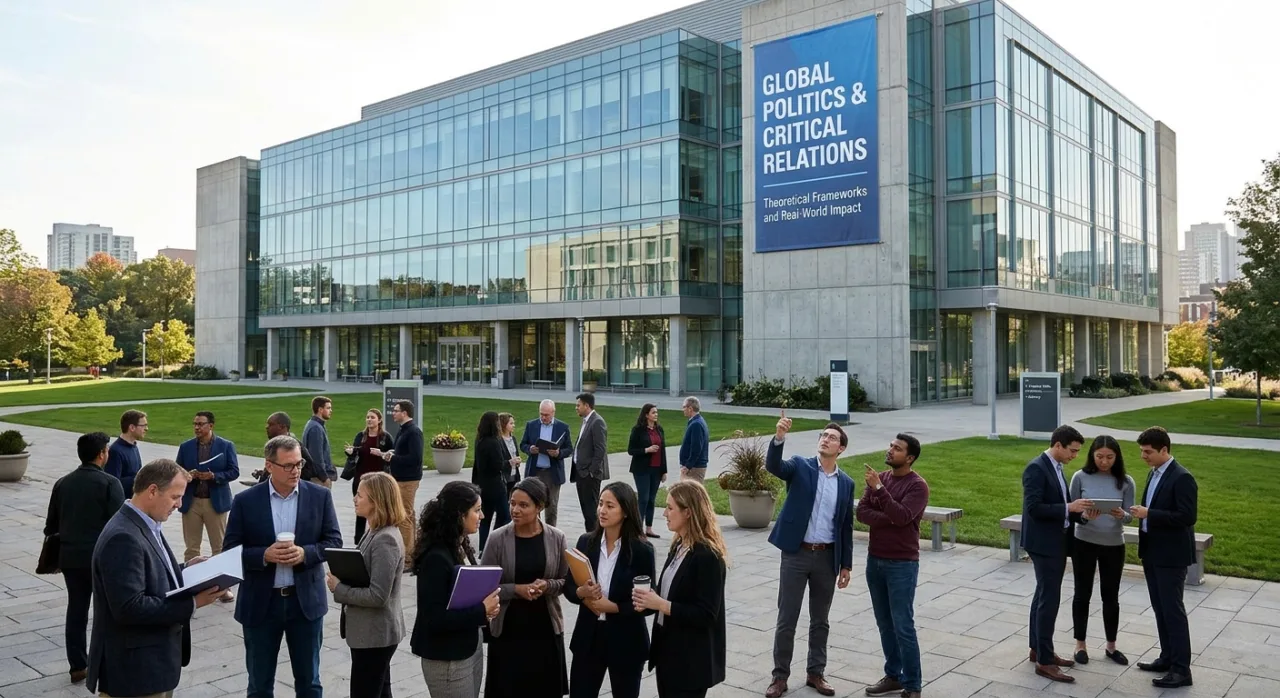
Given this reality, Critical IR must direct its analytical lens inward. Conventional academic critique is deeply entangled with the very crises it claims to oppose crises that are simultaneously economic, ecological, geopolitical, and ethnonational.
The professionalization of critical scholarship inadvertently accelerated the dissolution of democratic international order by trading substantive political strategy for insular academic signaling.
To understand how this occurred, critical scholars must examine specific operational choices:
-
Selection of Targets: The hyper-focus on deconstructing theoretical texts rather than confronting tangible economic and material structures.
-
Style and Presentation: The adoption of specialized, highly abstract prose that insulates scholars within academic echo chambers while stripping them of a meaningful public voice.
4. Moving Beyond the Outsider Aesthetic
At the heart of this crisis lies an intellectual aesthetic that rose to dominance in the late twentieth century: the systematic valorization of the peripheral perspective.
This posture allowed the academic “hipster” to critique power safely from a distance without engaging in the messy, compromising realities of actual political transformation. Over time, stylistic radicalism substituted for substantive efficacy. Scholars traded in high-level abstraction suitable for university seminars and peer-reviewed journals, but offered zero practical guidance or strategic vision for actors navigating real-world crises.
5. A New Framework for 21st-Century Critique
Critical scholars must abandon the comforting illusion that adopting a dissident theoretical posture is inherently emancipatory or politically effective. Confronting climate breakdown, democratic backsliding, resurgent authoritarianism, and escalating geopolitical conflict demands an entirely new mode of practice.
To regain relevance, Critical IR must commit to three structural shifts:
-
Direct Material Engagement: Move away from marginal posturing and engage directly with the complex architecture of global power and economic production.
-
Accessible Vocabulary: Build a persuasive language capable of communicating beyond academic departments to inform popular movements and policy interventions.
-
Constructive Building: Transition from a culture of permanent negation toward a grounded, self-aware practice focused on building resilient institutions and material solidarity.