
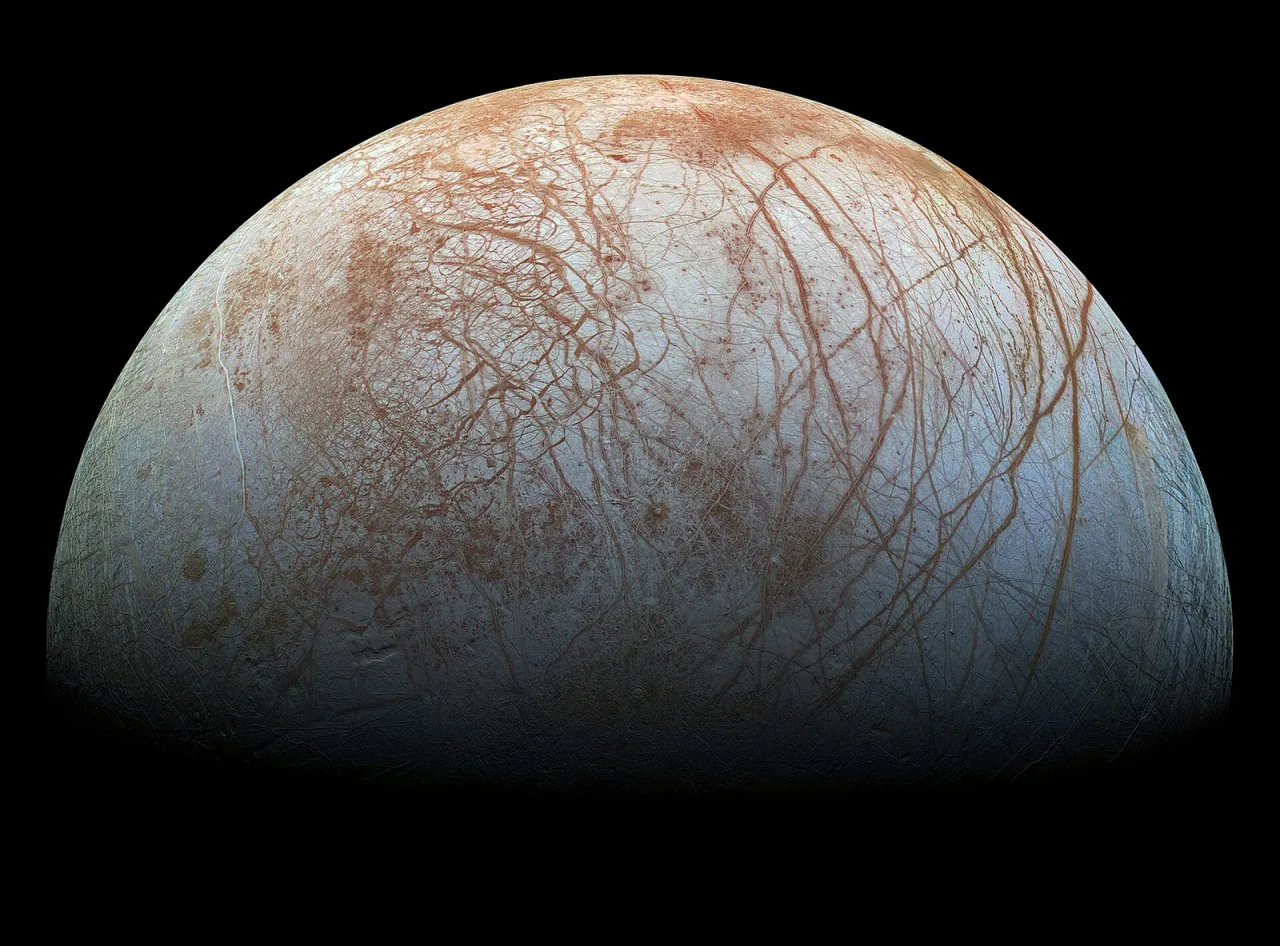
Beneath the cracked ice of Jupiter’s moon Europa is a global ocean that may hold twice as much water as all of Earth’s seas combined. NASA has sent a spacecraft to find out whether that ocean could support life. Europa Clipper, the largest planetary probe the agency has ever built, launched in October 2024 and is now several years into a long cruise. It is due to arrive at Jupiter in 2030, after a journey designed to get the heavy spacecraft to the outer solar system without a direct, faster path that its launch vehicle could not provide. Once there, it will fly past Europa nearly fifty times, coming as close as 25 kilometres to the surface, to study the ice, the water below and any plumes of vapour that may rise from cracks in the crust.
A habitable ocean, not a search for life itself
Europa is one of the most promising places in the solar system to look for life beyond Earth because it appears to have the three things life needs: liquid water, the right chemical elements and a source of energy. Heat from the way Jupiter’s gravity flexes the moon could keep the ocean liquid and drive hydrothermal vents on the seafloor, not unlike the vents on Earth that support ecosystems in total darkness. Clipper will not land, and it cannot detect life directly. Its nine instruments, including ice-penetrating radar, cameras, a magnetometer and spectrometers, are meant to work together: to map the ice shell, estimate the ocean’s depth and chemistry, and look for organic compounds, the chemical building blocks of life. If the ocean looks habitable, that would guide a future lander rather than close the question on its own.
A long flight through harsh radiation
The spacecraft has to survive the intense radiation around Jupiter, which is why its sensitive electronics sit inside a protective vault. Repeated flybys, rather than a long stay in orbit around the moon itself, are also a way to limit the time the probe spends in the worst of that radiation. The same mission should sharpen the picture of other icy ocean worlds, including Saturn’s moon Enceladus, which sprays water from its south pole. For now the work is patient: years of cruise, then a campaign of close passes once the spacecraft is in orbit around Jupiter, and then a careful judgment about whether Europa’s hidden ocean is a place life could exist today.