
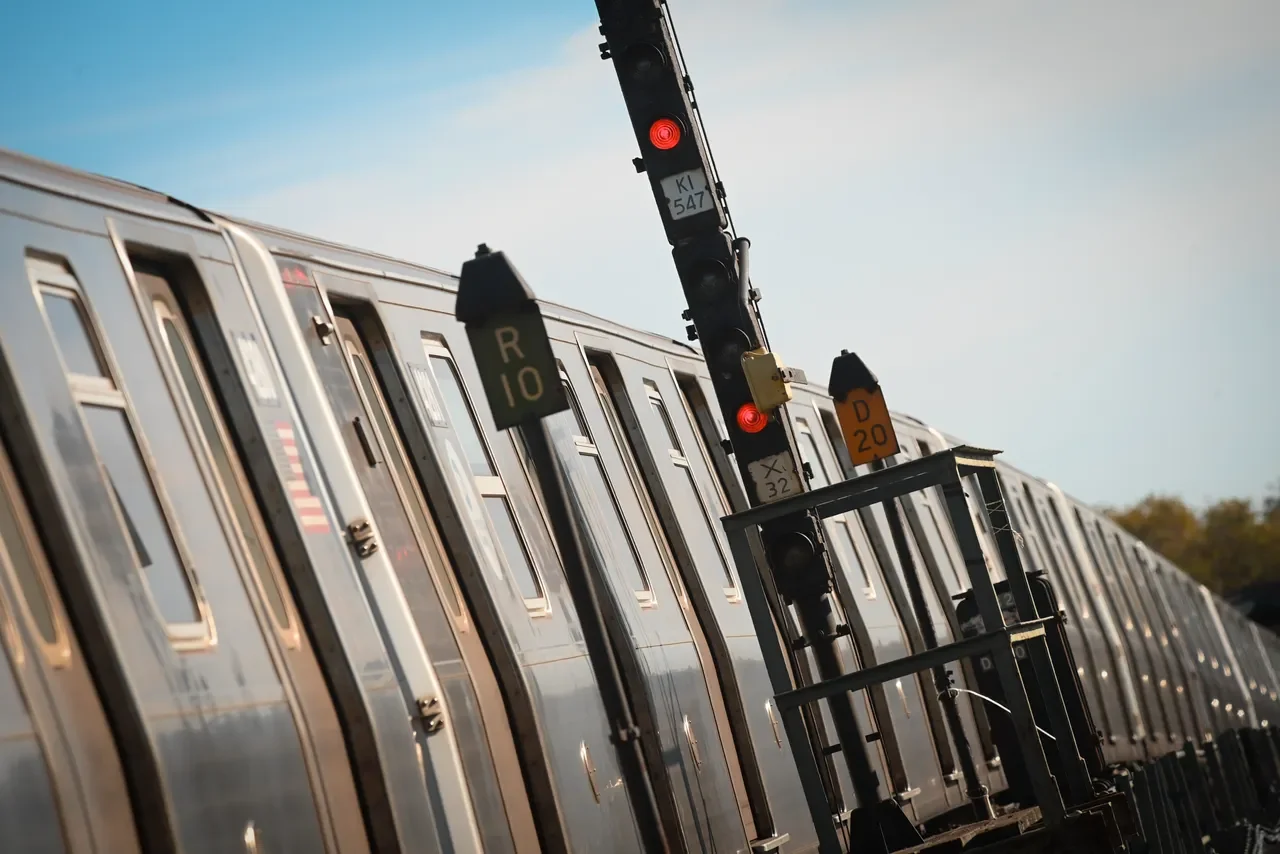
 On October 22, Governor Kathy Hochul set in motion the largest signal replacement project in the history of the Metropolitan Transportation Authority. The $1.9 billion project will replace the Depression-era switching hardware on the A and C lines with wireless Communications-Based Train Control (CBTC), covering 42 track miles and 23 stations in Brooklyn and Queens.
Signal failures are the biggest single cause of subway delays in New York, and the Fulton-Liberty corridor still runs on equipment installed when the IND Fulton Street Line opened in 1936. That is nearly nine decades of accumulated technical debt.
The Fulton Street Line in Brooklyn and the Liberty Avenue Line in Queens share signal infrastructure that predates the transistor. The existing system can tell whether a train is somewhere in a fixed track section, but not where inside that section it sits. That gap forces wide spacing between trains and caps how often service can run at peak times. Original parts have also become hard to source, so maintenance costs climb every year. MTA Chair and CEO Janno Lieber put it plainly: “Signal issues are the number one cause of subway delays.”
About 350,000 weekday riders travel through the project corridor between High Street in Brooklyn and Ozone Park–Lefferts Boulevard in Queens, and they absorb the cost of that old hardware daily. Once the upgrade is finished, all 750,000 people who ride the A and C lines on an average weekday should see better reliability.
CBTC replaces fixed-block logic with continuous wireless positioning, so the control center can track each train to within a few meters in real time. That removes the wide safety buffer older technology requires, which lets trains run closer together and raises service frequency on the existing tracks without laying new rail.
Earlier conversions point to real gains. After CBTC came online on the 7 line, on-time performance rose from 68% to 91%, and train speeds on the E line along the Queens Boulevard corridor climbed by roughly 10%. The A and C lines will also be able to work fully with the R211 subway car fleet, whose trains come with built-in CBTC receivers, which should shorten waits once the switch is complete.
The scope goes beyond signals. The project also covers upgraded tunnel lighting, new switches and heavy cabling to support future cellular coverage in the tunnels, which should help both riders and the crews who maintain the line overnight.
All $1.9 billion comes from the congestion pricing program, the tolling system that began charging drivers entering lower Manhattan in January 2025. Hochul framed the project as proof that the policy is delivering on its promise to modernize public transit.
Getting to stable funding was not smooth. After the program launched, the federal administration moved in early 2025 to revoke the initial federal approval, which set off months of litigation. In March 2026 a federal judge ruled that the effort to end the program was unlawful, clearing the way for the MTA to commit to large capital projects like this one.
A note on the numbers: when the MTA board approved the initial design-build contracts in December 2025, the Governor announced $1.75 billion covering the core CBTC contract and accessibility upgrades at five stations. The October 22, 2026 announcement put the signal modernization at $1.9 billion, which is the figure used here.
The contract structure also breaks with MTA tradition. Instead of splitting engineering, procurement and construction among different contractors, the agency combined them in one design-build award, given to L.K. Comstock & Railworks in December 2025 from three competing bids. MTA Construction & Development President Jamie Torres-Springer credited that structure, plus an installation approach that skips running legacy signals in parallel during the transition, for per-mile costs 33% below the average on earlier CBTC contracts.
The 2025-29 MTA Capital Plan builds on that model with $5.4 billion to modernize signals across more than 75 additional miles, including the Broadway N/Q/R/W, Liberty Avenue A, Rockaway A/S and Nassau Street J/Z lines. Fulton-Liberty is both the largest single signal contract in MTA history and the cost benchmark for what follows.
Work has already started. Phase 1 targets aging switches and more than 250 feet of specialized track between 104 St and 99 St in Queens. The MTA’s target for full completion is Q2 2032, which means roughly six years of complex overnight work on a system that runs around the clock.
That timeline faces pressure from the start. A July 2025 report by Time Out New York found that every active CBTC project in the subway was running late. The F line project in southern Brooklyn was three years behind, and the A/C/E upgrade under Eighth Avenue had slipped more than two years. An independent consultant’s review obtained by Gothamist found that two past contracts also went well over budget, and a recently completed signal project in Queens finished four years late.
Whether the design-build approach that cut per-mile costs by a third can also hold this project to its schedule, through six years of nightly track work, will decide if the MTA’s new model becomes the standard for how New York builds critical infrastructure.